
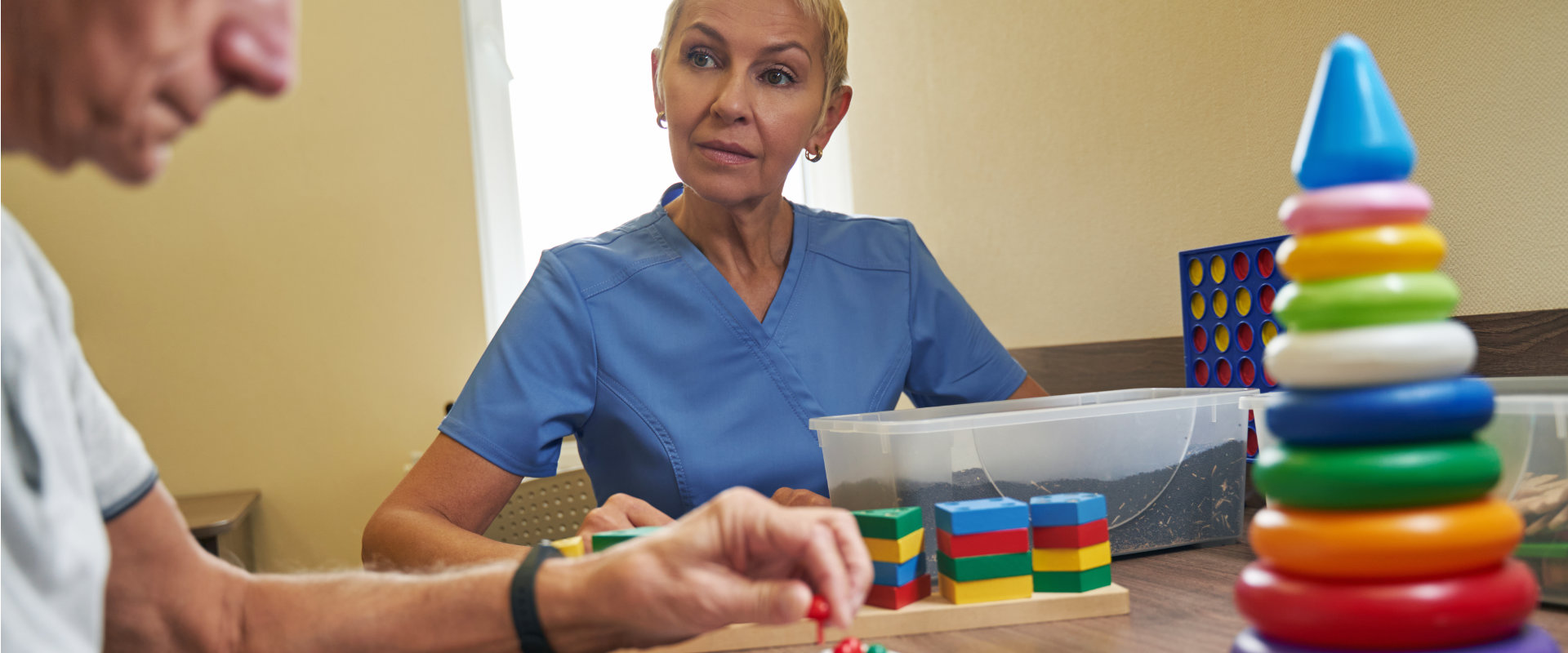

In our everyday lives, many activities seem to be taken for granted: getting dressed in the morning, climbing the stairs, preparing breakfast, going to work or playing with the children. But what happens when these simple actions become a challenge due to illness, disability or age-related limitations?
This is precisely where occupational therapy comes in, a medical-therapeutic measure that supports and accompanies people of all ages in regaining or maintaining their ability to act in everyday life. Its aim is to enable those affected to lead as self-determined a life as possible, be it after a stroke, in the case of developmental delays in children, psychological stress or physical impairments.
In this magazin you will find out exactly what occupational therapy means, the tasks and methods behind it, who it is suitable for and how it works in different areas of life.
Definition: Occupational therapy
Occupational therapy is a form of medical therapy that aims to improve or restore the ability to act in everyday life. The aim is to support and accompany people of all ages in their independence, participation and quality of life.
Origin of the term "occupational therapy"
The word comes from the Greek: "érgon" means work, deed or action, an apt description for the core of this therapy, which focuses on everyday activities.
Aims of occupational therapy
- Promoting independence in everyday life: Patients should be able to manage everyday tasks such as dressing, cooking, writing or shopping independently again.
- Restoring the ability to act: After accidents, illnesses or restrictions, targeted work is carried out to regain lost abilities.
- Maintaining existing abilities: Particularly in the case of chronic or progressive illnesses, the aim is to maintain existing abilities for as long as possible.
- Improved quality of life: greater independence, social participation and less need for assistance increase the personal well-being of those affected.
- Supporting participation in social and professional life: Occupational therapy helps people to take part in community life or the workplace again.
- Promotion of motor, cognitive and mental functions: These include, for example, mobility, coordination, attention, memory and self-esteem.
- Coping with stress and limitations: Occupational therapy offers strategies for dealing with pain, excessive demands, fears or changes in life.
- Training in self-care: Activities such as personal hygiene, eating and housekeeping are specifically trained.
- Promoting sensorimotor skills and perception: This can be particularly important for children, after strokes or with neurological disorders.
- Advice and guidance for relatives: The aim is to involve the entire environment in the therapy and thus improve the situation at home.
- Adaptation of the environment or use of aids: Housing advice, adapting the workplace or aids such as gripping pliers or writing aids make life easier for those affected.
- Enabling individual everyday activities: Occupational therapy helps people to organize their leisure time in a meaningful way and to find new hobbies or routines.
Tasks of occupational therapists
Occupational therapists work with their patients on individual treatment plans that are tailored to their needs, abilities and living environment. Their tasks include
- Analysis of skills and impairments
- Development of therapy goals
- Carrying out targeted exercises
- Documentation and progress monitoring
- Advice for relatives and caregivers
Who is occupational therapy suitable for?
Occupational therapy is as diverse as the people who make use of it and that is precisely what makes it so valuable. Whether young or old, physically restricted, mentally stressed or impaired by an illness in everyday life: Occupational therapy is aimed at people of all ages who are restricted in their ability to act or need support in coping with everyday life.
This form of therapy is used when everyday activities, such as dressing, writing, cooking or social interaction, are not possible or only possible to a limited extent due to physical, mental, cognitive or social impairments.
Occupational therapists not only accompany the direct treatment of patients, but also advise relatives, teachers, nursing staff or employers, always with the aim of enabling the greatest possible independence, participation and quality of life.
Children and adolescents in occupational therapy
Many children show abnormalities or delays in the course of their development that can affect their everyday life, their school career or their social interaction. In such cases, occupational therapy can provide targeted support and guidance.
Occupational therapists help children with, for example
- Perceptual disorders (e.g. sounds are perceived as unpleasant, stimuli are processed incorrectly)
- Fine motor problems (e.g. difficulties with writing, cutting or handicrafts)
- Learning and concentration problems (e.g. with AD(H)S or partial performance disorders)
- Social behavioral problems (e.g. aggression, withdrawal, lack of impulse control)
Through targeted exercises, playful forms of therapy and the development of structure, children learn to better understand and interact with their environment. The focus is always on the individual child with their abilities, needs and potential.
Early support: the earlier, the better
Early occupational therapy can make a significant contribution to improving participation in school, family and leisure activities. The aim is to prevent limitations from becoming chronic in the first place and to promote children's development in the best possible way, both in the motor and social-emotional areas.
Close cooperation with parents, educators and teachers is a central component of the therapeutic work.
Adults in occupational therapy
Even in adulthood, life can suddenly become unbalanced due to illness, injury or psychological stress. The consequences: everyday activities become difficult, independence is limited and quality of life suffers.
This is where occupational therapy comes in, with the aim of restoring the lost ability to act in everyday life or maintaining it as well as possible.
Typical areas of application for adults are
- After a stroke: to promote movement, speech comprehension and coping with everyday life
- For rheumatism: to relieve pain, improve mobility and use aids
- For depression or other mental illnesses: to structure the day, activate and promote social skills
- For muscular restrictions: to improve strength, coordination and functional movements
- For chronic pain: for pain management, body awareness and improvement of lifestyle
The therapy is individually adapted to the patient's needs, resources and goals. The aim is to enable the greatest possible participation in professional and private life, despite limitations.
Seniors in occupational therapy
As people get older, their physical and mental abilities change and many everyday tasks become more difficult or are only possible to a limited extent. This often results in a loss of independence, an increasing need for help and withdrawal from social life.
Occupational therapy offers older people targeted support so that they can live independently, safely and actively for as long as possible, even in old age.
Occupational therapy for senior citizens focuses on
- Fall prevention: Targeted movement and balance exercises improve mobility and reduce the risk of falls.
- Maintaining self-care: Activities such as personal hygiene, dressing, eating and housekeeping are trained so that senior citizens can remain independent for as long as possible.
- Dealing with dementia: Occupational therapy provides support in structuring everyday life, promotes orientation and offers support throughout the day.
- Training of fine motor skills and memory: With exercises for fine motor skills, dexterity and mental activation, everyday life is made easier and self-confidence is strengthened.
The therapists work closely with carers, relatives and doctors to develop an individually tailored treatment plan. The aim is to maintain the best possible quality of life, participation and dignity for senior citizens, whether in their own home, in a care home or in assisted living facilities.
Common areas of application for occupational therapy
The possible applications of occupational therapy are just as diverse as the people who benefit from it. Whether after a sudden illness, in dealing with a chronic disability or to support child development, occupational therapy is used precisely where everyday life becomes a challenge.
The focus is always on the question: How can a person live an active, self-determined and meaningful life despite limitations?
Occupational therapy is used in many medical and social areas: from neurology, psychiatry and orthopaedics to pediatrics, geriatrics and rehabilitation. It supports the recovery of lost abilities, provides support during phases of upheaval in life and helps to strengthen and rediscover existing resources.
Occupational therapy after a stroke
A stroke often changes life from one second to the next. Paralysis, speech disorders, concentration problems or the loss of fine motor skills are among the most common consequences. The arm, hand and shoulder are often particularly affected, which can severely restrict everyday movements.
Occupational therapy starts at an early stage to restore, promote or compensate for important functions. The focus is on helping patients to lead as independent a life as possible.
The measures include:
- Training everyday movement sequences (e.g. gripping, writing, holding)
- Promotion of gross and fine motor skills
- Body awareness training
- Use of targeted therapeutic exercises for the affected side of the body
- Advice on aids, e.g. special cutlery or dressing aids
- Development of daily structure and support in coping with everyday life
Occupational therapy works closely with speech therapy and physiotherapy and makes a significant contribution to restoring the patient's ability to act.
For physical disabilities
People with physical disabilitieswhether congenital or acquired, often face major challenges in everyday life. Activities such as washing, shopping, getting around or participating in social life can seem limited or even impossible.
Occupational therapy helps people to deal with these changes and find new ways of coping:
- Adaptation of the environment (e.g. barrier-free living)
- Instructions on how to use aids such as wheelchairs, grippers or walking aids
- Training of replacement strategies to compensate for lost movements
- Promotion of residual functions and development of strengths
- Advice on workplace adjustment or professional reintegration
Occupational therapy for mental illnesses
Also for mental disorders such as depressionanxiety disorders, schizophrenia or burnout occupational therapy is a valuable form of therapy that goes far beyond traditional talking therapies.
The aim here is to bring structure, meaning and stability back into the daily lives of those affected. The therapists work in a resource-oriented and everyday manner.
Typical occupational therapy goals in this area:
- Establishing a regular daily routine
- Promotion of motivation, activity and self-drive
- Strengthening self-esteem and social behavior
- Support in coping with stress
- Promotion of fine motor skills, creativity and concentration through creative activities
- Social skills training in group therapies
Occupational therapy offers a protected space in which people can learn in small steps to regain control over their lives and are supported and encouraged in the process.
Forms of treatment and methods of occupational therapy
Different methods and forms of therapy are used in occupational therapy, depending on the clinical picture, age, limitations and goals of the patient. All measures are aimed at promoting the ability to act in everyday life and finding individually tailored solutions.
Motor-functional treatment
Targeted promotion of mobility and strength
This form of treatment is used when movement sequences, muscles or joints are impaired, for example after an injury, operation or chronic illness.
The aims of this treatment are
- Improvement of gross and fine motor skills
- Building and maintaining muscle strength
- Training coordinated hand, arm and shoulder movements
- Promoting mobility and self-care
The exercises are individually adapted and range from everyday activities to special motor training.
Sensory-integrative therapy
Promoting perception in children
This form of therapy is primarily aimed at children with perceptual disorders when sensory stimuli (e.g. touch, sounds, movement) are not processed correctly.
The goals are:
- Improvement of sensory processing (e.g. feeling, seeing, hearing, balance)
- Support with the integration of these impressions in the brain
- Promoting concentration, body awareness and the joy of movement
Treatment is playful and is carried out in close consultation with the parents in order to optimally support the child's development.
Neurotraining
Strengthening cognitive abilities after brain damage
Targeted neurotraining is essential after neurological diseases such as strokes, traumatic brain injury or degenerative diseases such as Parkinson's or multiple sclerosis.
The main areas of therapy are:
- Memory, attention and orientation training
- Promotion of problem-solving strategies and planning skills
- Developing skills relevant to everyday life despite cognitive limitations
- Improving independence of thought and action
Training for everyday activities
Mastering self-sufficiency and everyday life
The focus here is on targeted practice of everyday activities, especially for people who are limited in their independence due to accident, illness or disability.
Typical training contents are
- Dressing
- Cooking and housekeeping
- Writing or operating devices
- Counting money and shopping
The aim is to promote independence and ensure participation in social life.
Group and individual therapy
Individual support and social learning
Occupational therapy can take place both in an individual setting and in groups, depending on the patient's objectives and needs.
- Individual therapy deals specifically with individual problems. It is suitable for physical limitations, neurological deficits or psychological stress, for example.
- Group therapy focuses on social skills. For example, participants learn teamwork, communication and social behavior, which is particularly important for children and people with mental illnesses.
Both forms often complement each other and are combined depending on the therapeutic goal.
The DVE - Association of Occupational Therapists
The German Association of Occupational Therapists (DVE) is the central professional representation for occupational therapists in Germany. It is committed to the further development, recognition and assurance of quality in occupational therapy in a variety of ways.
What does the DVE do?
- Representation of professional interests vis-à-vis politicians, health insurance companies, authorities and other institutions
- Organization of further and advanced training to keep therapeutic knowledge up-to-date and qualified
- Publication of specialist publications, guidelines and information material
- Supporting occupational therapists in everyday practice, e.g. with legal or organizational issues
- Public relations work to raise awareness of the importance and possibilities of occupational therapy

Why is the DVE important?
Through its work, the association makes a significant contribution to ensuring the quality of occupational therapy care, further developing the profession and strengthening the interests of therapists and their patients. At the same time, it ensures that occupational therapy receives the attention it deserves in society and the healthcare system.
Conclusion: Occupational therapy - a form of therapy for a better quality of life
Occupational therapy means more than just training movements or learning new skills, it is a way back to an active, self-determined life. It supports and accompanies people on their way to greater ability to act, independence and participation, regardless of age or illness.
Whether for children, adolescents, adults or senior citizens, occupational therapy offers many people the opportunity to actively shape their lives and cope with everyday life despite difficulties.
Tip: If you or a relative are affected by limitations, disorders or illnesses, talk to your doctor about the possibility of taking advantage of occupational therapy. The path to a better quality of life can start today.