
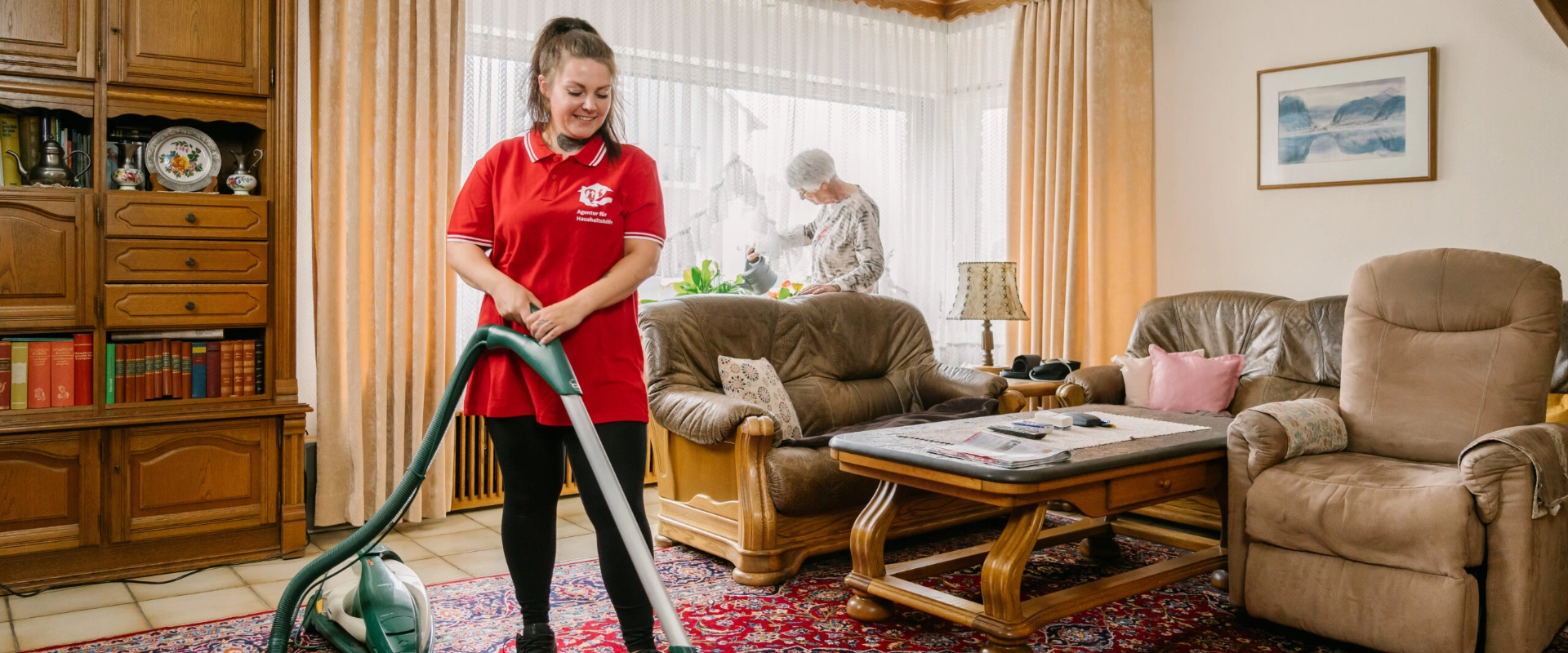

Many people want help around the house, either because work and family leave little time, because certain activities are no longer possible after an illness or operation, or because senior citizens increasingly need help in their everyday lives.
The question quickly arises: What is the difference between cleaning help and domestic help?
Although the two terms are often confused in everyday life, there are important differences that determine costs, entitlements, health insurance benefits, areas of responsibility, requirements and areas of application.
Why it is important to know the difference
The everyday lives of many households are becoming increasingly complex. Appointments, children, jobs, caring for relatives or health challenges lead to a considerable burden for many people. Support in the household can provide relief - but what kind of help is right for whom?
Briefly summarized:
- A cleaning assistant concentrates on cleaning activities.
- A home help supports the entire household and helps with everyday tasks, often with the possibility of costs being covered by health insurance or care insurance.
If you know the difference, you can select the right service, avoid misunderstandings and benefit financially.
Definitions of terms - cleaning help vs. domestic help
What is a cleaning assistant?
A cleaning assistant, also known as a cleaner or cleaning lady, carries out traditional cleaning work in a private household or office.
Her focus is on:
- Cleanliness
- Hygiene
- Surface care
- Basic cleaning
Cleaning assistants usually work in fixed time intervals, e.g. 2 hours per week or 3 hours every two weeks.
Typical tasks of a cleaning assistant
- Vacuum cleaning and floor care
- Bathroom and kitchen cleaning
- Wiping furniture and walls
- Waste disposal
- Window cleaning
- Descaling or special cleaning tasks (by arrangement)
What cleaning assistants do NOT do:
- Childcare
- Purchases
- Cooking
- Accompaniment to appointments
- Everyday organization
- Care support
This makes them very different from domestic helpers.
What is a home help?
Domestic help supports private individuals, families, senior citizens, people in need of care and people with health restrictions comprehensively in everyday life - and not just when cleaning.
It helps where everyday life is difficult or impossible to cope with alone.
Typical activities of a domestic help
- Cleaning (like a cleaning assistant)
- Washing, ironing, sorting laundry
- Shopping & errands
- Cooking and preparing meals
- Childcare or supervision
- Support in coping with everyday life
- Organization of the budget
- Light gardening work (e.g. flower care)
- Accompaniment to medical appointments or authorities
- Support after operations or in the event of illness
A domestic help can therefore be used more widely, is more flexible and is specifically geared to different life situations.
Differences between cleaning help and domestic help at a glance
| Category | Cleaning help | Domestic help |
|---|---|---|
| Cleaning | ✓ | ✓ |
| Laundry care | ✗ | ✓ |
| Cooking | ✗ | ✓ |
| Shopping | ✗ | ✓ |
| Childcare | ✗ | ✓ |
| Support for illnesses | ✗ | ✓ |
| Organization & budget system | ✗ | ✓ |
| Gardening | rare | frequently |
| Cost coverage by health insurance companies | rare | Yes, pro rata from care level 1 |
Domestic help is much more comprehensive and in many situations completely replaces your own household management.
Complete housekeeping" includes all activities that are necessary to ensure that:
- children are cared for
- Food is available in the household
- Hygiene is guaranteed
- daily processes work
- Order and safety are guaranteed
Who is a cleaning or domestic helper suitable for?
Cleaning help:
- Professionals
- Households that only need cleaning and cleaning staff
- People who can keep things tidy but need help with cleaning
Household help:
- Families with small children
- Seniors
- People after illness or surgery
- Households with a care degree
- People with stress, exhaustion or health problems, who need help in the household
- Anyone who needs permanent or flexible everyday support with various household tasks
Areas of application - when is cleaning help enough, when do you need domestic help?
When a cleaning assistant is sufficient
- Apartment is basically organized
- It's all about cleanliness
- No health restrictions
- Little time, but no need for additional support
When domestic help is useful or necessary
- serious accident, illness, operation
- Burn-outexhaustion, mental illnesses
- Need for care or degree of care
- Pregnancy (medically certified), puerperium
- Household with children under 12 years
- Senior citizens looking for support
- Everyday life cannot be managed alone
In many of these cases, even the health insurance or care insurance fund will pay.
Conditions for the assumption of costs for household help by the health insurance fund
Statutory health insurance companies cover the costs of domestic helpif certain medical and family requirements are met.
1. medical certificate/medical necessity
The health insurance company pays if a doctor confirms that the person:
- ill,
- restricted after an operation,
- hospitalized,
- seriously ill,
- pregnant or
- in the puerperium is
and therefore cannot run the household themselves.
2. children under 12 years of age in the household
This applies to many health insurance companies:
- There must be at least one child under the age of 12 living in the household.
- The age limit does not apply to children with disabilities.
In this case, benefits are often granted more generously.
3. no other person living in the household can take over the household
The benefit is only granted if:
- no partner,
- no other adult household member
can take on the tasks, for example due to work or personal restrictions.
4. the failure is temporary
The health insurance fund pays for household help for temporary absences, for example:
- after operations
- for acute illness
- during a hospital stay
- for severe infections
- in high-risk pregnancies
- in the puerperium
5. application before or shortly after the start of the assignment
- A medical form ("Home help according to § 38 SGB V") must be submitted.
- The cash register must approve the use.
Conditions for the assumption of costs by the care insurance fund
1. a care degree must be available
Already from care level 1 those in need of care benefit from various benefits from the long-term care insurance fund, such as the relief amount of €131, which can be used to offset recognized services. From care level 2 the care allowance, which is freely available, can also be used.
2. household help falls under "respite care services"
- 131 per month for each care level
- can be used for household help and everyday support
Prerequisite:
- The provider, such as the agency for domestic help must be recognized.
3. respite care or short-term care possible
If the caregiver is absent, domestic help may be billed for the following services:
- Preventive care (up to €1,612 per year)
- Short-term care (can be combined)
This applies, for example, if:
- the family caregiver becomes ill
- an emergency occurs
- Recreational leave is necessary
4. support in everyday life
The care insurance fund pays for domestic help if it is required for:
- Relief
- Accompaniment
- Support in everyday life
and help the person in need of care to cope with everyday life.
Briefly summarized: When does who pay?
The health insurance company pays if:
✔ Medical necessity
✔ Household cannot be managed independently
✔ Children under the age of 12 live in the household (usually required)
✔ Assignment is limited in time
✔ Medical certificate is available
The care insurance fund pays if:
✔ Degree of care available
✔ Respite services are being used
✔ The caregiver is absent (respite care)
✔ The service provider is a recognized provider
Costs, prices & financing options for a cleaner or domestic help
How much does a cleaner cost?
Prices vary greatly depending on the city, experience and scope.
Typical guide values:
- Private, mini-job basis: 13-17 € per hour
- Via agency: 20-30 € per hour
- Professional cleaner with invoice: 25-40 € per hour
Other cost factors
- Window cleaning
- Basic cleaning after conversion
- Removal of stubborn dirt
- Size of the apartment
- Travel costs
What does domestic help cost?
As the range of tasks is broader, the prices are somewhat higher.
Typical costs:
- Private, mini-job basis: 14-18 € per hour
- Professional domestic help from agency: 25-40 € per hour
- Special everyday care assistance: 30-45 € per hour
Costs covered by health insurance
The health insurance fund covers the costs of domestic help if:
- a medical certificate is available
- everyday life and household are not possible without help
- a child under the age of 12 lives in the household (with parents)
- an operation, pregnancy or illness is present
Typical applications:
- Bone fracture
- Surgery on the knee, hip, spine
- Inpatient treatment
- Serious illness with restrictions
The costs can be covered between 100% and partial amounts, depending on the insurance company.
Support from the care insurance fund
Other regulations apply for care degrees.
Important services
- 131 € monthly relief amount
- Preventive care and short-term care (up to €3,539 per year)
- Household-related services via cooperation partners
This enables senior citizens and people in need of care to finance household help in the long term.
Legal basis
A cleaning assistant or domestic help should be privately employed and legally registered be registered.
Advantages:
- Accident insurance
- legally compliant
- Tax benefits
- Secure payment
Agency vs. private employment of domestic help
Private employment
- Cheaper, but more responsibility
- Employer obligations
- Replacement difficult in the event of illness
Agency
- Tested forces
- Replacement in the event of failure
- Legally compliant mediation
- Transparent prices
- tax deductible
Everyday situations - examples that make the difference visible
Example 1 - Young family after caesarean section surgery
After a caesarean section, the young mother is partially or completely incapacitated for several weeks. She can only move to a limited extent, is not allowed to lift heavy weights and needs time to heal. The father works full-time and can only take over the household to a limited extent.
As there is a child under the age of 12 living in the household, there is a clear entitlement to household help from the health insurance fund. The medical certificate confirms that the mother is temporarily unable to manage her household herself.
Solution:
The health insurance fund authorizes household help for several hours a day. The support is provided by a professional agency so that all invoices are correct.
Example 2 - Senior citizen with care level 2
A 78-year-old senior citizen lives alone in his apartment. He is mentally fit but physically limited: climbing stairs is difficult for him, as are longer distances. He has care level 2, which entitles him to a monthly relief amount of €131 and care allowance.
The senior wants to live independently in their familiar surroundings for as long as possible, but needs regular support in everyday life.
Solution:
A qualified home help comes twice a week and is financed by the relief amount and the care allowance from the care insurance fund.
Example 3 - Working couple
A professional couple both work full-time and have a demanding working week. The home stays clean, but there is regularly no time for thorough cleaning. Everyday life is tightly scheduled, so household chores quickly become an additional burden.
Solution:
The couple decide to hire a cleaner to come twice a week for two hours at a time. The tasks are clearly defined and repeatable.
Example 4 - Long-term illness
A person living alone suffers from a chronic illness or is in a long-term rehabilitation phase following an operation. Standing, bending or carrying are hardly possible. Even everyday tasks such as cooking or shopping are a major challenge.
A doctor's prescription confirms that the person is unable to manage the household themselves. They are therefore entitled to household help from the health insurance fund, often for several weeks or months.
Solution:
A trained home help comes regularly, usually 3-5 times a week, depending on the extent of the restriction.
Tips for choosing the right support
Selection criteria for cleaning assistants
- Experience and reliability
- Clear arrangement of tasks
- Availability and proximity
- Transparent prices
- Arrange a trial cleaning
Selection criteria for domestic help
- empathetic and friendly person
- Experience in dealing with families or senior citizens
- Flexibility
- Knowledge about coping with everyday life
- Possibility of cash accounting
FAQ - Frequently asked questions
What is the difference between cleaning help and domestic help?
A cleaning assistant cleans the apartment, a home help provides additional support in everyday life, cooks, washes, accompanies, organizes and helps with illness or care needs.
Who pays for domestic help in the event of illness?
In many cases, the health insurance company will cover all or part of the costs.
How can I find domestic help in my area?
Via agencies, online portals, regional providers.
How much does a cleaner cost per hour?
Depending on the region, between 13 and 40 euros.
The right support for your household
A cleaning assistant is ideal for pure cleaning.
A domestic help goes far beyond this and is particularly valuable for families, senior citizens and people with health restrictions.
If you understand the difference, you can choose the right support and, under certain circumstances, take advantage of financial benefits from health insurance or care insurance.
A professional agency ensures that you have reliable, tested and competent helpers at your side - for an easier everyday life, a better quality of life and relief in the household.