
In order to provide successful care at home, adaptations may need to be made to your own home. Depending on the individual's physical limitations, stairs, bathrooms, doors and other elements can become major obstacles in daily life.
Find out here how you may be able to receive financial support from your care insurance to carry out conversion measures that reduce these barriers. A grant of up to 4,000 euros is possible.
What are measures to improve the living environment?
Adapting your relative's living space with measures to improve their living environment makes it possible to create a barrier-free living situation in their own four walls in the long term. These measures can include both comprehensive conversions and the installation of technical aids such as grab rails or emergency call systems.
Simpler measures, such as making light switches or sockets easier to reach, are less costly to implement. More complex measures often require intervention in the fabric of the building. Typical conversions include the removal of door thresholds for barrier-free access or the installation of aids in the bathroom. If necessary, the outside area can also be made barrier-free.
Special case for communal living
If several senior citizens in need of care live together in one household, this results in a special situation when it comes to subsidies for measures to improve the living environment. For example, if both parents have a care degree and are cared for at home, both are entitled to the subsidy.
The subsidy is limited to a maximum of four people who live and are cared for in the same household. This means that the maximum subsidy is 16,000 euros in total (four beneficiaries each entitled to 4,000 euros). If more than four people are entitled to the subsidy, it is divided proportionally between the various insurance providers. This special regulation is of particular benefit to outpatient residential groups.
Prerequisite for measures to improve the living environment from the care insurance fund
It is important that the person concerned has a care degree in order to receive benefits from the care insurance fund. If there is not yet an official care degree, check whether a care degree can be applied for can be applied for. The severity of the need for care is irrelevant - every person in need of care receives the same allowance of up to 4,000 euros. In addition, the care must take place in the home environment, be it in your own apartment, your own house or in a shared flat.
Criteria for measures to improve the living environment
There are three different criteria that must be met in order to receive up to 4,000 euros from the care insurance fund for measures to improve the living environment.
The prerequisite is that...
- the measures ensure that care can take place in the home environment.
- the measures ensure that care in the home environment is made easier.
- the measures enable the person in need of care to lead a more independent lifestyle.
Adaptation of living space according to care level
To receive the subsidy for home adaptations, you need a recognized care degree. Regardless of your care level, the subsidy is always 4,000 euros.
This subsidy applies per measure and per person:
- Per measure: One measure refers to all conversions that are applied for at the same time and take into account the current state of health. If the condition changes significantly and additional modifications are required, you can apply for the subsidy again.
- Per person: If several people with a care degree live in the same household, they can apply for the subsidy for up to four people per measure. This means that a subsidy of up to 8,000 euros is possible for a married couple and up to 16,000 euros for a flat-sharing community.
How to use the care insurance subsidy
The grant for improving the living environment is aimed at making the home suitable for care, which includes the entire living area including the staircase. Conversions to the outside of the home, such as at the entrance, in the courtyard or in the garden, can also be financed with this grant. The main priority is to design the conversion in such a way that it facilitates or enables care at home.
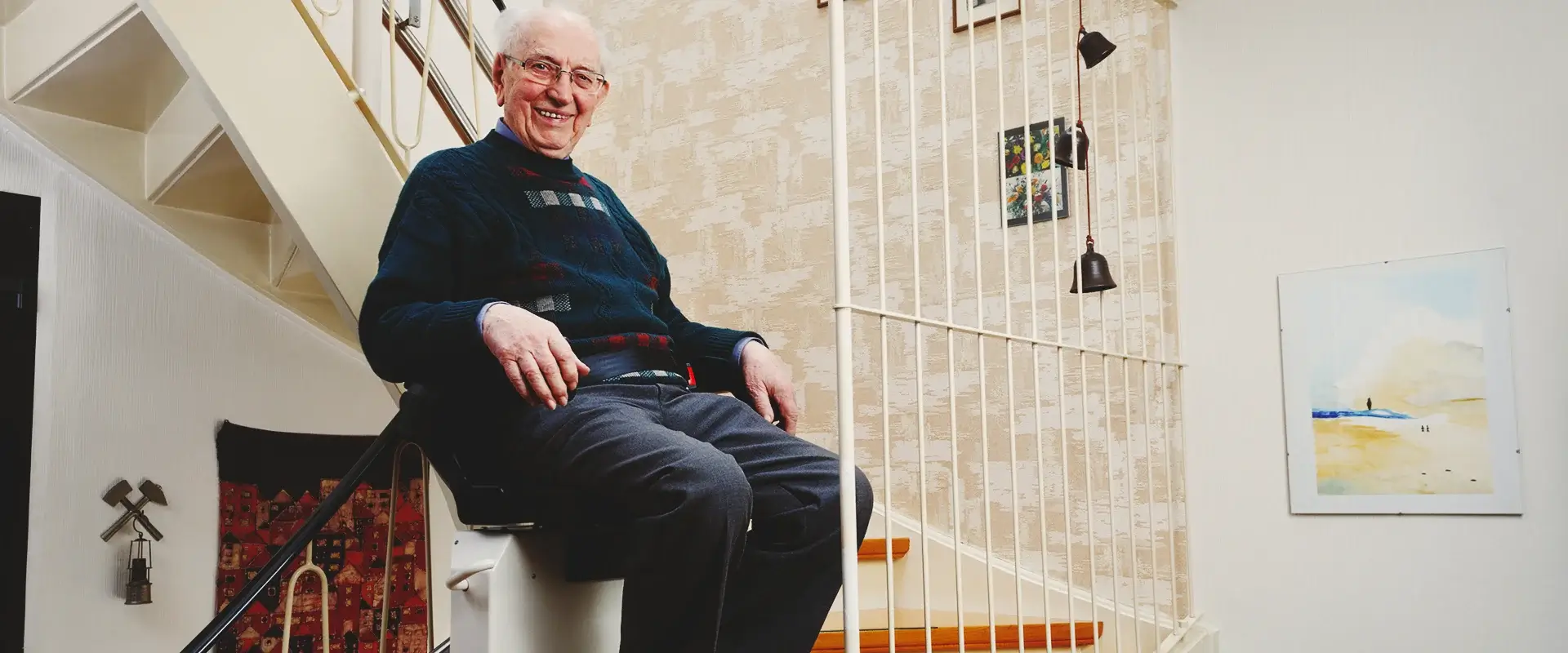
Staircases in particular are a major challenge for many older people. Climbing the steps requires strength and poses a considerable risk of falling. Falls in the home, especially due to stairs, are a frequent cause of accidents. A stairlift significantly reduces this risk by moving back and forth between floors at the touch of a button. Stairlifts can also be installed in narrow stairwells.
The cost of a stairlift starts at around €3,800 and varies depending on the type of staircase and the number of floors. It is advisable to obtain a non-binding offer including a cost estimate before installation. You then submit this quotation to the care insurance fund together with an informal application for improvement of the living environment. The grant from the care insurance fund can then enable you to move around easily, even in winding and steep staircases.
In the bathroom, there are also numerous opportunities to use the home improvement grant to simplify home care. By installing a bathtub door, the high entrance can be reduced by around 30 centimetres. This door can be closed watertight and can be visually adapted to the existing bathtub so that a relaxing full bath is still possible.
It is even safer if the bathtub is converted into a shower. This leaves only a small residual threshold, enabling safe and independent personal hygiene. The cost of a bath door starts at around 1,200 euros, while a conversion to a shower costs around 4,000 euros. In both cases, experience has shown that the grant of 4,000 euros covers the entire cost, leaving no personal contribution.
However, the measures for people with a care degree can look very different and be very individual. Nevertheless, it can generally be said that the funding finances measures that have various advantages for the person concerned:
- There are various ways of adapting the living space to the needs of the person in need of care, such as installing wheelchair-accessible heights, fitting grab rails or installing stair lifts.
- These are measures that make structural changes to the building and alter it permanently, such as converting a bathtub into a walk-in shower.
A move to another floor or to a barrier-free apartment is also considered an improvement to the living environment if this helps to make care possible or easier. In such cases, you should ask your care insurance fund directly whether a subsidy for a care move is possible. This move is sometimes also referred to as a move for the elderly.
Examples of measures to improve the living environment
The selection of measures requiring conversion that can receive a grant depends on your individual health restrictions and your living situation. It is important that it is clear how the proposed measure will enable or facilitate your care or promote your independence. Nevertheless, there are some typical examples that are often approved.
For which measures are grants awarded?
Examples of typical measures to improve the living environment:
- Purchase and installation of a stairlift
- Installation of a home lift or external elevator
- Non-slip steps in the stairwell
- Installation of railings on both sides of the staircase
- Installation of a barrier-free shower
- Converting a bath into a shower with handles
- Installation of a bath tub lift
- Installation of easily accessible light switches
- Installation of a barrier-free WC
- Lowering wall units in the barrier-free kitchen
- Installation of clearly recognizable grab handles and support rails
- Installation of motion detectors for the night-time route to the toilet
- Adjusting the height of furnishings
- Enlargement of doors
- Removal of door thresholds
- Creation of orientation aids for the visually impaired
- Installation of an intercom system
- ... and much more
No subsidies are granted for repairs and general modernization. Similarly, measures that are convenient and practical but not essential for effective home care are not eligible for a grant.
For which measures are no subsidies granted?
Grants are typically not awarded for the following measures:
- Equipping the apartment with a telephone, refrigerator or washing machine
- Improving thermal insulation and soundproofing
- Repair of damaged steps
- Fire protection measures
- Creation of functional lighting in the entrance area/stairwell
- Wheelchair garage
- Construction of a covered seating area
- Electric drive of an awning
- Replacement of the heating system, hot water preparation
- Cosmetic repairs (painting, wallpapering walls and ceilings, replacing floor coverings)
- Elimination of moisture damage
- General modernization measures
Relocation as a measure to improve the living environment
It may be necessary to move to a new home in order to secure the individual care situation or to make it possible in the first place. In such cases, the care insurance fund can subsidize the relocation costs, for example for a move from an apartment on the upper floor to a first floor apartment.
The need and the reasons why the current home can no longer be used appropriately are usually examined and assessed individually by an expert, often in consultation with you and on your premises. This involves examining whether, for example aids could improve the situation. If a modification is necessary in the opinion of the assessor, the scope of the necessary measures will be discussed and determined. However, it is important to note that the decision to grant subsidies for structural alterations is at the discretion of your care insurance fund or the assessor. The care insurance fund will not always be obliged to subsidize structural alterations.
Grants for measures to improve the living environment can be provided not only by your care insurance fund or long-term care insurance company, but also by your landlord, the Versorgungsamt (social welfare office), vocational rehabilitation providers (such as statutory accident insurance, statutory pension insurance, Federal Employment Agency) or foundations. For people in need of care who are employed and have a recognized degree of disability of at least 50%, the care insurance fund is generally not eligible to provide subsidies for measures.
Measures to improve the living environment in a rented apartment
If you live in a rented apartment, no express permission from the landlord is required for minor alterations such as the installation of grab rails or additional lighting. However, the landlord's consent may be required for major alterations that involve significant interference with the fabric of the building.
Are repair services for conversions that have already received financial support covered by the care insurance fund?
According to a ruling by the Federal Social Court on January 25, 2017 ([mfn]Ref.: B 3 P 4/16[/mfn] Ref.: B 3 P 4/16 R), your health insurance fund will not generally cover the costs of maintenance or repair of home conversions that have already received financial support, unlike in the case of care aids.
A grant for maintenance or repairs is only possible if the maximum amount of EUR 4,000 has not been fully utilized in a previously approved and subsidized conversion measure. In such cases, the grant is limited to the remaining amount available. It is not possible to receive a new grant for repairs or maintenance.
There is an exception if a measure to improve the living environment that has already been implemented is completely unusable and needs to be replaced. In this case, the replacement is regarded as a further measure and is again financially supported with a maximum of EUR 4,000.
Is the subsidy of 4,000 euros possible several times?
It is possible to receive the grant for improving the living environment more than once, especially if the care situation has changed and new measures are required. The same rules apply for a repeat application as for the first application. However, there are additional requirements:
- Home care is made easier by the second improvement to the living environment.
- The care situation has changed to such an extent that further measures are required to improve well-being.
- To reapply for a grant to improve the living environment, the problem that was solved by the previous measure must not have existed when the first application was submitted.
Application for measures to improve the living environment
You can submit an uncomplicated and informal application for home environment improvement directly to your care insurance fund. It is advisable to apply for a grant for a measure to improve the individual living environment before the measure begins.
After your application has been received by the care insurance fund, a care specialist from the Medical Service (MD) will check during consultation appointments whether measures to improve the living environment are actually necessary and whether all requirements have been met. They will then make a recommendation on the necessary structural adaptations or aids.
Even in an informal application, some mandatory information must be provided so that it can be processed further.
The applicant should state their name and insurance number in the application. It is also important to state whether they live in an owner-occupied or rented property. The desired measure should be clearly described, including a rough estimate of the costs (a cost estimate should be enclosed). The reasons why this measure is necessary should also be explained. If other measures have already been subsidized in the past, it is important to specify these.
When should I apply for measures to improve my living environment?
It is advisable to apply for the subsidy before starting the conversion to ensure that the care insurance fund recognizes the conversion as an improvement to the living environment and grants the subsidy. However, if the application is submitted at a later date, the approval process becomes much more complicated.
The care insurance fund finds it difficult to check the necessity of the measure afterwards. In this case, the burden of proof lies with you and obtaining the subsidy will be costly and time-consuming. If the retrospective application is rejected, you will be stuck with the entire conversion costs. All detailed invoices must be submitted for the retrospective grant application.
There are three simple steps to follow:
- Before you submit the application, you should obtain cost estimates from various providers. The care insurance fund needs these in order to assess the measure.
- Submit an informal application for a subsidy to your care insurance fund.
- As soon as the grant has been approved, you can start with the conversion.
What should I do if my application for measures to improve my living environment has been rejected?
If your application for a subsidy to improve your living environment is unusually rejected by the care insurance fund, it is important to submit an appeal in writing within 30 working days. Every rejection notice must contain a reason, which you should check carefully.
Your objection obliges the long-term care insurance fund to re-examine the facts of the case. Your objection should clearly explain why the improvement to the living environment is necessary. A medical certificate describing the circumstances can be helpful here. You will not incur any costs for the objection or for a possible re-assessment by the Medical Service.
It is advisable to submit a careful initial application right from the start in order to increase the chances of a quick and positive response from the care insurance fund.
How often can I apply for measures to improve my living environment?
To illustrate this, we have an example for you:
In February, various improvements are needed in the living environment of a wheelchair user in need of care who is looked after by his wife. These include the installation of fixed ramps, the widening of doors and the adaptation of furniture to make it easier to use the wheelchair.
In accordance with Section 40 (4) SGB XI [mfn]Section 40 (4) SGB XI[/mfn], these measures are regarded as a single improvement to the living environment and can be subsidized with a maximum of €4,000.00.
Later, due to the increasing mobility restrictions of the person in need of care and the decreasing support from his wife, it is determined that it is no longer possible to use the existing bathtub. In order to continue providing care at home, it is decided to install a floor-level shower. Due to this change in the care situation, additional measures to improve the living environment are required, which can again be subsidized with a maximum of €4,000.00.
Further subsidies for measures to improve the living environment
In addition to support from the care insurance funds, there are other financial subsidies that can help you to improve your relative's living environment. One option is financial support from the KfW Bank (Kreditanstalt für Wiederaufbau)[mfn]Website of the KfW Bank (Kreditanstalt für Wiederaufbau)[/mfn], which supports projects for age-appropriate home adaptation and associated conversion measures.
The KfW Bank's funding program 159, called "Age-appropriate conversion - investment grant[mfn]KfW Age-appropriate conversion (159)[/mfn]", accepts applications for funding for various measures up to €50,000. Many individual measures to reduce barriers are also subsidized by the KfW Bank. It is important to note that it is not possible to receive both the care fund grant and the KfW Bank grant for one conversion measure. An "either/or" principle applies here.
In addition to financial support, it is possible to partially deduct the costs of self-funded measures from tax. The prerequisite for this is a certificate from the health insurance company's medical service. The amount of the personal contribution, which is deductible as a "reasonable burden", depends on income and marital status.
With the KfW Conversion Barrier Reduction (455-B)[mfn]KfW Conversion Barrier Reduction (455-B)[/mfn] funding program, KfW Bank grants up to €6,250 in subsidies for age- and disability-friendly conversion measures. To apply for a grant from KfW Bank, you will need cost estimates for your planned measures.