
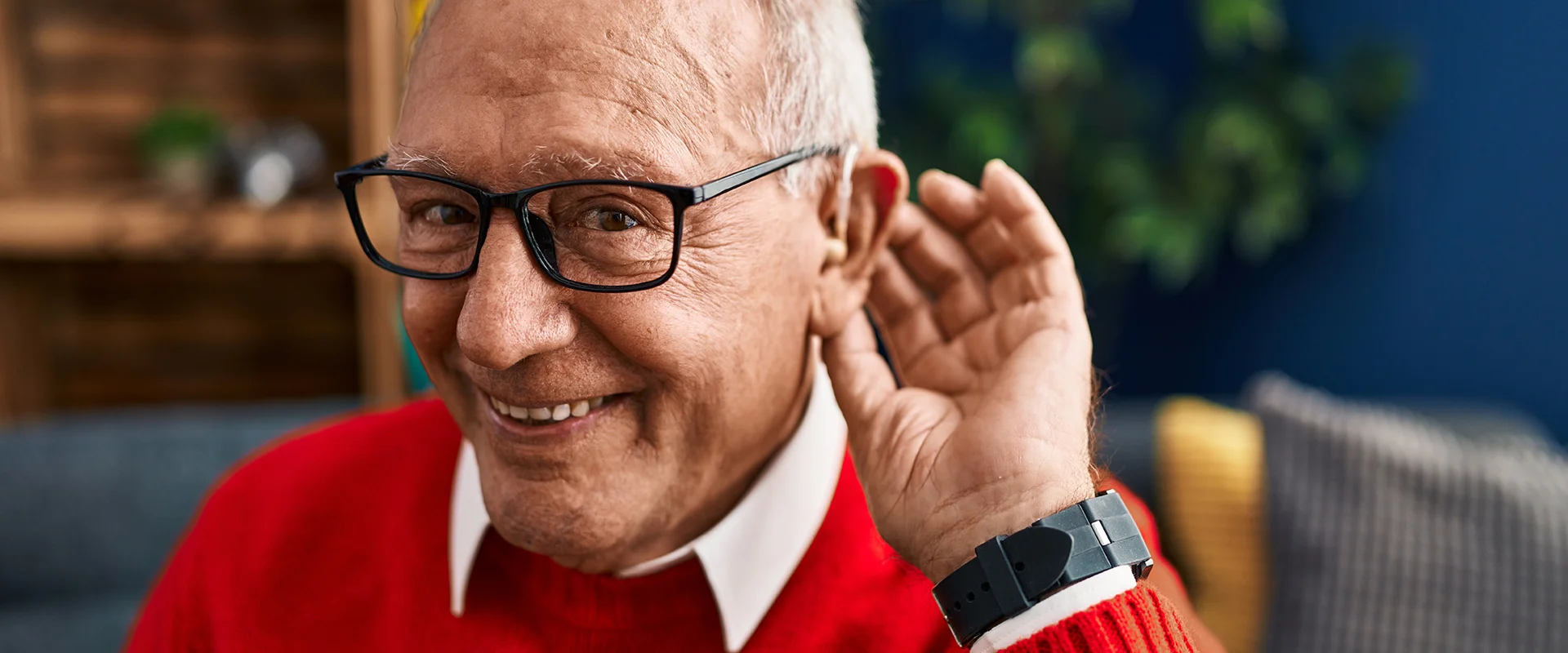

Hearing loss in old age can affect many people - as we get older, we experience a natural, age-related deterioration of the hearing organ and brain. The finely tuned mechanics in our ears get older and no longer function as smoothly as they did when we were younger. However, this age-related hearing loss and the associated age-related hearing loss should not cause immediate concern as long as it is treated promptly and appropriately.
Find out here about the causes and diagnosis of age-related hearing loss and learn more about aids and treatment options to improve quality of life in old age.
What is age-related hearing loss?
Age-related hearing loss, also known as presbycusis (medical term: H91.1 according to ICD-10 [mfn]H91.1 according to ICD-10[/mfn], refers to the gradual loss of hearing due to natural age-related processes that occurs after the age of 50. This condition usually affects both ears equally and worsens continuously if it is not treated or compensated for.
Around a third of those affected are at least 65 years old, and in Germany alone between 20 and 30 million people are affected by hearing loss.
How does hearing change with age?
It is quite common to experience reduced hearing performance in old age. Around a third of people over the age of 65 suffer from age-related hearing loss, studies show. The onset of hearing loss may not be noticed immediately as the changes are gradual and insidious. Initially, higher frequencies are often affected, which can lead to women's and children's voices being perceived less clearly or certain sounds such as birdsong no longer being heard. Over time, the restriction can extend to other frequency ranges, making it more difficult to follow conversations and only "snippets of words" can be understood.
How does presbycusis occur?
Not every form of hearing loss that occurs with age falls under the category of age-related hearing loss. Rather, age-related hearing loss is a specific type of hearing loss and belongs to the group known as sensorineural hearing loss.
Symptoms of age-related hearing loss
If you notice that your hearing is gradually deteriorating, it can be difficult to assess whether you are suffering from age-related hearing loss. If you have any doubts about your hearing performance or are told by family members and friends, it is advisable to consult a doctor.
Here are some signs that could indicate that you or your loved ones are suffering from age-related hearing loss:
- Difficulty understanding words clearly, especially in noisy environments.
- The need to turn up the volume on the TV or music system in order to understand the content.
- Frequently asking questions or asking the other person to repeat what they have said, especially if they are speaking quietly or are further away.
- Fatigue during a conversation due to intense concentration to grasp the content of the conversation, especially in busy, noisy places or with strong background noise.
- Indications that you are speaking louder than usual.

What should I do if I have hearing loss in old age?
Experiencing age-related hearing loss can be very challenging. You may withdraw from social activities as you find following conversations uncomfortable. Participating in social life may require a considerable amount of effort, as you need a lot of concentration to be able to understand the other person to some extent. It is particularly important that you do not hide away because of your hearing loss, but consult an ear,nose and throat specialist [mfn]otorhinolaryngologist [/mfn](ENT).
An ENT specialist has various ways of getting to the bottom of the causes of your hearing loss. First, the doctor will ask you about your symptoms and then examine your ear more closely. It may already be possible at this point to determine whether, for example, earwax is blocking the ear canal, which can then be removed.
Various tests can be carried out to assess the degree of your hearing loss, including hearing tests with acoustic signals or tests to check the activity of your sensory cells. Based on the results, the doctor will make a treatment recommendation. For example, a middle ear infection is usually treated with antibiotics. If you are diagnosed with age-related hearing loss, it will usually persist, but with the support of various aids, your hearing can often be improved and compensated for.
Age-related hearing loss: causes
When our ears and the brain that processes the signals from the ears are healthy and young, our hearing functions excellently. However, as we get older, the hair cells in our ears in particular deteriorate and are no longer able to process sound as effectively as they did when we were younger. These cells wear out over time, which means that older people can no longer perceive acoustic stimuli as clearly.
The cause of presbycusis is therefore mainly due to the natural ageing process, which also affects our ears. Nevertheless, a number of risk factors can be differentiated that can promote presbycusis in old age.
Risk factors for presbycusis
Even if not everyone becomes hard of hearing in old age, there are certain risk factors that can promote the development of age-related hearing loss.
These include, for example:
- Cardiovascular diseases
- Circulatory disorders
- Long-term noise exposure
- Hereditary disposition
- Diabetes mellitus
- Smoking
- Experience with sudden hearing loss
Age-related hearing loss due to noise
Many people are exposed to excessive noise in the course of their lives - whether through work-related activities or regular listening to loud music. Over time, this can lead to hearing loss.
Prolonged exposure to noise can not only cause psychological impairment, but can also lead to hearing damage. Hearing loss due to prolonged exposure to noise is the most widespread recognized occupational disease in Germany. According to the Federal Guild of Hearing Aid Acousticians (biha), around 5,500 new cases occur every year.
How can presbycusis be prevented?
Although it is not possible to completely prevent age-related hearing loss, there are some measures that everyone can take:
- Protect yourself from noise: always wear hearing protection during loud activities and avoid listening to excessively loud music all the time.
- Protect your ears: Cover your ears with a hat when you go outside, even in cold weather.
- Give up smoking: Smokers have a higher risk of hearing loss compared to non-smokers.
- Take care of your blood pressure and heart health: cardiovascular diseases can increase the risk of age-related hearing loss.
- Treat diabetes mellitus: Experts have found that diabetes can damage hearing, so appropriate treatment is important.
If you or your family members show the first signs of presbycusis, you should not hesitate to consult a doctor and have yourself examined. The ENT doctor (ear, nose and throat specialist) will examine you and possibly make a diagnosis.
Excessive wax in the ear can also often be the cause of hearing loss.
Types of hearing loss
There are different types of hearing loss that can occur at any stage of life and have different causes.
Experts generally classify them into three main categories:
- Conductive hearing loss
- Sensorineural hearing loss
- Combined conductive and sensorineural hearing loss
In addition, there are other categories for classifying hearing loss, such as central hearing loss and unilateral hearing loss.
Conductive hearing loss
Conductive hearing loss occurs when the transmission of sound from the eardrum to the inner ear is disturbed, often due to problems such as injuries to the eardrum.
This type of hearing loss is more common in children and adolescents. It can be genetic, i.e. due to heredity, or caused by injuries or tumors.
An example of conductive hearing loss is hereditary hearing loss [mfn]hereditary hearing loss[/mfn], which affects more than a third of people with hearing loss.
Sensorineural hearing loss
In the case of sensorineural hearing loss, the ability to recognize sound is impaired. This may be because the hair cells in the inner ear no longer function properly or the auditory nerve is damaged. This is often caused by diseases of the inner ear or a sudden hearing loss.
Examples of a sensorineural hearing loss are
- Cochlear hearing loss [mfn]Cochlear hearing loss[/mfn]: This occurs when the inner ear is damaged, causing hearing loss.
- Neural hearing loss or retrocochlear hearing loss [mfn]Neural hearing loss or retrocochlear hearing loss[/mfn]: This type of hearing loss occurs when the auditory nerve is damaged.
- Sensorineural hearing loss [mfn]Sensorineural hearing loss[/mfn]: If the hearing loss is caused by damaged hair cells in the inner ear, it is referred to as sensorineural hearing loss.
Combined conductive and sensorineural hearing loss
In the case of combined conductive and sensorineural hearing loss, both types of hearing loss are present, as the name suggests. This form is also known as combined hearing loss and can occur, for example, due to diseases of the middle and inner ear.
Central hearing loss due to a stroke or dementia
Central hearing loss can occur in people who have suffered a stroke or suffer from dementia. Unlike conventional hearing loss, the cause is not in the ear, but in damage to the brain.
One-sided hearing loss
Unilateral hearing loss, where only one ear is affected, can have various causes, similar to bilateral hearing loss. If unilateral hearing loss occurs suddenly, this may be due to a tumor on the affected side. However, an infection with herpes viruses can also damage the auditory nerve on the affected side to such an extent that unilateral hearing loss occurs.
Severity of hearing impairment
Experts classify hearing impairments into different degrees, from mild hearing loss to almost complete deafness. They use audiograms to determine how loud a sound must be in order to be perceived by a person with hearing impairment.
The degree of hearing impairment is expressed in decibels (dB), the unit of measurement for loudness.
The hearing threshold is the minimum sound intensity or sound pressure level that a person needs in order to just perceive a sound. It is the lowest sound level that can be registered by the ear. The hearing threshold varies depending on the frequency of the sound and is measured in decibels (dB). The lower the hearing threshold, the more sensitive the ear is to the sound in question.
The World Health Organization (WHO) [mfn]World Health Organization (WHO)[/mfn] published an updated classification for the categorization of hearing impairments in adults in 2021.
This classification divides hearing impairments into six degrees of severity:
- No hearing impairment: Less than 20 dB
- Mild hearing loss: 20 to 35 dB
- Moderate hearing loss: 35 to 50 dB
- Moderate hearing loss: 50 to 65 dB
- Severe hearing loss: 65 to 80 dB
- Severe hearing loss: 80 to 95 dB
- Complete hearing loss (deafness): from 95 dB
No hearing impairment
There are no problems hearing sounds in a quiet environment.
In a noisy environment, there is either no or only minimal difficulty in hearing sounds.
Mild hearing loss
In a quiet environment, there are no problems hearing spoken language.
In a noisy environment, it may be difficult to hear spoken language.
Moderate hearing loss
In a quiet environment, it may be difficult to hear and understand spoken language.
In a noisy environment, you may have difficulty hearing and participating in conversations.
Moderate hearing loss
In a quiet environment, it may be difficult to understand conversations, although high-pitched voices can be heard without problems.
In a noisy environment, it can be difficult to hear most of what is being said and to actively participate in conversations.
Severe hearing loss
In a quiet environment, you may not be able to hear most conversations and may have difficulty hearing and understanding high-pitched voices.
In a noisy environment, it can be extremely difficult to hear what is being said and actively participate in conversations.
Severe hearing loss
In a quiet environment, extreme difficulties can occur when hearing high-pitched voices.
In a noisy environment, conversations cannot be heard at all.
Complete hearing loss
In both quiet and noisy environments, it is not possible to hear speech or most environmental sounds.
Presbycusis diagnostics
In order to make a diagnosis of age-related hearing loss and to provide appropriate treatment with hearing aids or hearing aids it is crucial to rule out other possible causes or diseases. This often involves an examination with an ear microscope, during which the ear, nose and throat specialist checks the structure of the patient's eardrum to ensure that there are no obvious problems such as tears or holes.
To further confirm the diagnosis, a tone audiogram and a speech audiogram are usually carried out. If other causes can be ruled out and the diagnosis of age-related hearing loss is confirmed, the ear, nose and throat specialist often recommends fitting hearing aids. Modern hearing aids are able to effectively compensate for age-related hearing loss and enable those affected to understand speech, sounds and noises almost perfectly.
Tone audiometry
In tonal audiometry, the patient is played various tones at different volumes, both high and low. During the test, the patient indicates when they can still just hear the sound. This creates a curve that shows the patient's hearing threshold. In a patient with age-related hearing loss who undergoes this test, a loss in the range of high tones in particular is detected.
This means that the patient's hearing threshold will decrease, particularly in the range of high-pitched sounds. This hearing loss often exceeds the age-related hearing thresholds. In the advanced stages of the disease, low-pitched sounds may also be impaired.
Speech audiometry
Speech audiometry methods aim to test the understanding of speech in different acoustic environments.
In Germany, the Freiburger Einsilbertest is often used, which tests the understanding of monosyllabic words under various conditions, including background noise. The APHAB questionnaire [mfn]APHAB questionnaire [/mfn](Abbreviated Profile of Hearing Aid Benefit) is used to assess subjective hearing impairment, which measures intelligibility in various everyday listening situations. The APHAB is also available in German and can be obtained free of charge
Presbycusis therapy
There is currently no drug treatment to restore hearing in old age, so it is all the more important to protect the ears well. Nevertheless, hearing aids can be used effectively to compensate for hearing loss in old age. The use of a hearing aid can help people with age-related hearing loss to regain a significant degree of quality of life. By preventing long-term consequences such as social isolation or depression depression, hearing aids help to improve overall well-being.
Early action in obtaining suitable hearing aids can significantly reduce the effects of age-related hearing loss. Early fitting of hearing aids can help to prevent progressive hearing loss. The earlier treatment with hearing aids begins, the sooner serious hearing loss can be avoided.
Consequences of untreated presbycusis
People with age-related hearing loss often face several challenges in everyday life that go beyond mere comprehension problems.
Social withdrawal is a common reaction to communication difficulties. Without appropriate treatment, age-related hearing loss can lead to social isolation and even depression. There is also evidence that age-related hearing loss can increase the risk of mental decline and dementia.
Increased everyday problems can also occur. People with impaired hearing often have difficulty localizing sounds, which can lead to problems with orientation. This can be dangerous in road traffic, as they may not be aware of approaching vehicles or warning signals. In addition, the risk of falls increases as the sense of balance in the inner ear can also decrease with age.
Presbycusis: treatment and associated risks
There are various options available to counteract age-related hearing loss, depending on its cause.
These include:
- Hearing aids
- Cochlear implants [mfn]Cochlear implants[/mfn]
- Tinnitus masker [mfn]Tinnitus masker[/mfn]
- Operational measures
Other treatment options for hearing loss include
- Hearing training: Exercises to improve or maintain hearing.
- Sign language: An alternative method of communication for people with severe hearing loss or deafness.
- Lip reading: The ability to read words from a person's lip movements can be helpful in improving communication.
It is also important to note that mental health problems such as depression or anxiety can affect hearing ability, especially in old age. In such cases, psychotherapeutic treatments can be helpful.
Hearing aids
There are different types of hearing aids, including in-the-ear devices (ITE hearing aids) and behind-the-ear devices (BTE hearing aids). These devices can be individually adapted to the needs of each patient.
The decision to prescribe a hearing aid is made after an examination by an ENT specialist in accordance with the guidelines for assistive devices. In collaboration with the patient, the hearing aid acoustician selects suitable devices and fits them. After fitting, the success is checked and documented by the ENT specialist.
In most cases, timely fitting with hearing aids can lead to a significant improvement in hearing. Studies have shown that hearing aids can improve social and emotional functions, communication and cognitive characteristics, even if the level of normal hearing is not fully achieved.
A Cochrane review [mfn] Cochrane review[/mfn] found that hearing aids significantly improve hearing-specific quality of life and greatly enhance the ability to listen in adults with mild to moderate hearing loss. Self-contained hearing aids provide effective compensation for hearing loss in most people.
The main reasons why many people do not use their hearing aids are problems with the fit of the earmolds and discomfort with loud noises. Hearing therapy approaches such as audiotherapy can improve the acceptance of hearing aids and support central processing. However, long-term results on the long-term and regular use of hearing aids are still lacking.
Cochlear implants
If the auditory nerve is intact but the inner ear is no longer functioning properly, a cochlear implant can be an effective solution for age-related hearing loss. These implants are inserted in a minor operation and take over the function of the cochlea. The implant is a tiny electronic device that is inserted where the inner ear no longer functions properly.
In contrast to conventional hearing aids, a cochlear implant goes beyond their function. It serves as a substitute that transmits sound signals directly to the brain. For this reason, such an implant is already useful for moderate hearing loss in both ears, especially if conventional hearing aids are not sufficiently effective. The cochlear implant is becoming more and more popular and is an increasingly attractive alternative to conventional hearing aids.
Tinnitus masker
If tinnitus is the cause of age-related hearing loss, a tinnitus masker could offer a suitable solution. This device masks the ringing in the ears, which may provide relief for the person affected.
Operational measures
Depending on the type of hearing loss, various surgical procedures are available to older patients to improve hearing, but the evidence for these is limited. Surgery on the middle ear rarely involves risks such as impaired taste, damage to the inner ear with possible impairment of hearing and/or balance function and injury to the facial nerve. If patients suffer from chronic inflammation in the ear canal or cannot tolerate conventional hearing aids, bone-anchored hearing aids may be an option. Taking into account medical and audiological indications as well as anatomical conditions, these patients can expect improved speech understanding and an increased quality of life.
In the case of chronic middle ear infections such as cholesteatoma [mfn]cholesteatoma[/mfn], which can cause potentially life-threatening complications, the focus is on the surgical removal of the focus of inflammation. This can also lead to an improvement in hearing. In addition, otosclerosis [mfn]otosclerosis[/mfn], which exists in addition to age-related hearing loss, can be successfully treated with stapesplasty at an advanced age.
Age-related hearing loss: tips for everyday life
If you or a relative notice a deterioration in your hearing, it is important not to shy away from going to the doctor or hearing aid acoustician.
Please note the following:
- Sometimes a supposed age-related hearing loss can simply be caused by a blocked ear.
- The timely use of hearing aids can counteract a further deterioration in hearing performance.
- With improved hearing, participation in life becomes safer and more fulfilling. Conversations become understandable again, going to the theater or cinema becomes a pleasure and even birdsong in the garden can be enjoyed again. This contributes significantly to the quality of life in old age.
- It is important to realize that a hearing impairment is not a disgrace. Those affected should be open about their impairment and also ask their conversation partners and relatives for understanding.
Communication aids for people with hearing loss
Here are some tips to help you cope better with your hearing impairment and communicate more successfully:
- Ask that conversations take place in a quiet environment, away from loud noises such as the television.
- Repeat what has been said and make sure that you have understood it correctly. Don't be afraid to ask for a repeat if necessary.
- Turn towards the other person while you are speaking and ask them to do the same. Closer distance can make communication easier.
- Also pay attention to the facial expressions and gestures of the person you are talking to. These non-verbal signals can help you to better understand what is being said.