
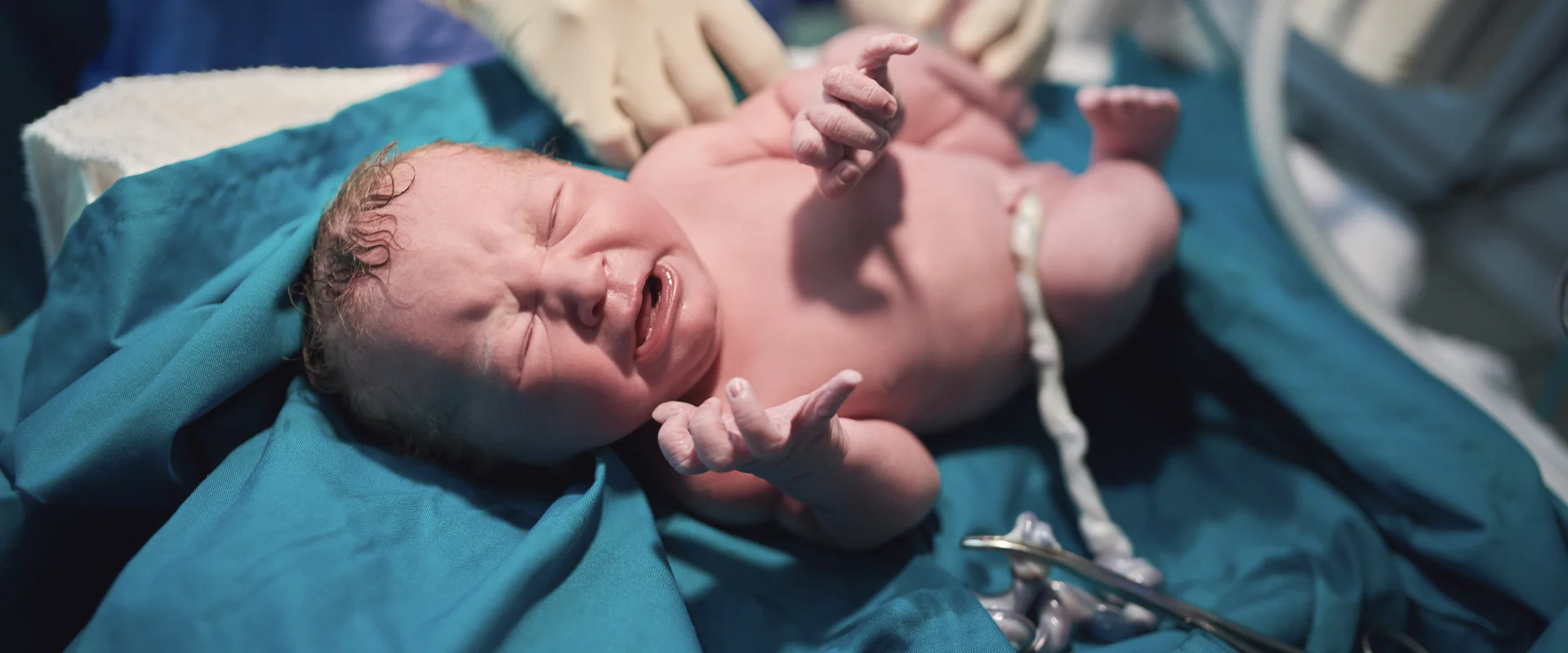

Ms. S., 34, was pregnant with her second child. It had been a smooth pregnancy—until the moment of delivery. In the delivery room, everything suddenly looked different: her baby’s heart rate dropped, the midwife called the surgical team, and the doctor said calmly but firmly, “We’re going to the OR right now.” Within minutes, Ms. S. was lying on the operating table; her husband wasn’t allowed to come in—general anesthesia. When she woke up, her son was already two hours old.
Stories like Ms. S.’s are not uncommon. An emergency cesarean section—known medically as an “emergency cesarean” or “red cesarean”—is the backup plan when a natural birth poses a life-threatening risk to the mother or baby. In this article, you’ll find all the key information about emergency cesarean sections: the reasons for them, the procedure, how they’re performed, post-operative care, and, most importantly, the support you’re entitled to afterward.
Ms. S. recounts: straight from the delivery room to the operating room
Ms. S. is one of many women whose childbirth experience changed in a matter of seconds. “One moment everything was going according to plan,” she says, “and the next, someone else was in control of my life.” Experiences like this leave a lasting mark—and not just physically. The relief that both mother and child are safe is mixed with fear, a loss of control, and profound emotional exhaustion.
What Ms. S. knows now is that she is not alone in this experience. And she knows that after a birth like this, she needs someone to help with the day-to-day tasks, because healing takes time.
What an emergency C-section means for the mother and baby
An emergency cesarean section is a medical procedure performed under extreme time pressure when the health of the mother or baby is in immediate danger. It differs from a scheduled cesarean section in one key way: there is no time for preparation in the usual sense. Nevertheless, the safety of the mother and baby is the top priority in every hospital, and the teams are fully prepared for exactly such situations.
Understanding Emergency Cesarean Sections – Definition, Frequency, and Procedure
About 30 percent of all births in Germany today are cesarean sections. Some of these are scheduled, some are elective (performed because they became necessary during labor), and a smaller proportion are actually true emergency cesarean sections.
Emergency cesarean section, emergency C-section, and scheduled C-section – the differences
In everyday hospital practice, there is a clear hierarchy of urgency. A planned cesarean section is scheduled weeks in advance, giving everyone involved time to prepare, including providing the pregnant woman with detailed information and obtaining her consent. A secondary cesarean section arises during an ongoing labor but is not an acute life-threatening emergency. An emergency cesarean section, also known as an emergency C-section or “Sectio Rot,” represents the highest level of urgency: the mother or child is in acute danger of death, and every minute counts.
Cesarean Section: Medical Background in Simple Terms
The medical term for a cesarean section is *sectio caesarea*, or *sectio* for short. In a cesarean delivery, the baby is delivered surgically through an incision in the lower abdomen. Modern medicine is very safe today, and these procedures generally proceed with few complications. Nevertheless, a cesarean section—whether planned or performed as an emergency—is a full-fledged surgical procedure with all that entails: a surgical team, anesthesia, post-operative care, and recovery time.
E-E Time: Why Every Minute Counts
In the case of a Sectio Rot, the so-called E-E time—decision-to-delivery time—applies. It refers to the time between the doctor’s decision and the birth of the child. In most hospitals, this time is less than 20 minutes; in acute emergencies, it is even significantly shorter. This strict time limit ensures that the newborn can be cared for as quickly as possible.
Reasons for an emergency cesarean section
There are many reasons for an emergency C-section. However, they all have one thing in common: they involve the immediate safety of the mother or the baby. It’s worth knowing the most important ones—not to cause fear, but to understand why doctors act so quickly in such a situation. Those who familiarize themselves with the reasons before giving birth often enter the delivery room feeling more relaxed: While knowledge is no substitute for experience, it can help alleviate fear.
Labor arrest, fetal distress, and abnormal heart sounds
A common cause is labor arrest: The labor does not progress despite strong contractions; the baby does not fit through the pelvis; or the contractions are insufficient. A second major group of reasons involves abnormal fetal heart sounds: an indication that the baby is at risk due to oxygen deprivation. A prolapsed umbilical cord, premature placental abruption, or an abnormal fetal position can also necessitate an emergency cesarean section.
Life-threatening situation for mother or child – when every second counts
In rarer cases, the mother’s own life is at risk, for example due to severe preeclampsia or massive bleeding. In all these situations, the decision is made quickly: the safety of the mother and child is the top priority. In an emergency, there is rarely time to obtain detailed consent; the hospital team documents the data and the birth situation and acts in a way that gives the mother and child the best possible chance of survival.
Procedure, execution, and duration of an emergency cesarean section
Anyone who has never experienced an emergency C-section can hardly imagine how quickly it all happens. Often, only a few minutes pass between the decision and the birth. But behind the apparent chaos lies a meticulously planned procedure that every team in the operating room has practiced down to the last detail. The procedure is carried out according to clear standards.
From the code to the delivery – what happens in the OR
As soon as the decision is made, the midwife or doctor calls for a code. The surgical team, anesthesiologist, pediatrician, and nursing staff gather in the operating room. The pregnant woman is brought to the operating table, covered, and disinfected. In an emergency cesarean section, general anesthesia is almost always used because it takes effect faster than spinal anesthesia. Within a few minutes, the baby is born, and the pediatrician takes over the initial care of the newborn.
Safety for Mother and Child During the Procedure
The procedure itself usually takes 30 to 60 minutes; the baby is delivered within 5 to 10 minutes, followed by care of the uterus, abdominal wall, and incision site. Throughout the entire operation, the surgical team monitors circulation, breathing, and blood values. Modern medicine has made the emergency cesarean section a very safe procedure today, even if it feels anything but calm for those involved. In most hospitals, the procedure is regularly practiced: doctors, nurses, and anesthesiologists train together so that every step is executed perfectly when it matters most.
General anesthesia, the surgical team, and your partner by your side
In the case of a scheduled C-section, the partner is usually allowed to be present in the operating room. With an emergency C-section, however, the situation is different: general anesthesia, time constraints, and cramped quarters rarely allow for it. For many women and their partners, this is one of the most difficult moments.
After an emergency C-section – Postoperative care and recovery
The story doesn’t end with the surgery. Postoperative care in the hospital usually lasts four to six days. During this time, the mother receives close monitoring, her incision is checked, and she carefully practices taking her first steps again. Postoperative care continues at home, provided by a midwife, a doctor, and, last but not least, by you yourself.
Complications, Scarring, and Physical Recovery
As with any surgery, complications can occur: wound infections, blood clots, and heavy bleeding. Compared to the past, these risks are minimal today. Healing the scar takes patience; internally, the tissue heals in about six to eight weeks. Externally, the scar often closes faster, but the deeper tissue takes longer. During this phase, you should avoid lifting anything heavy (not even your baby plus the diaper bag), refrain from making sudden movements, and take breaks.
The emotional side: fear, grief, relief
Physical healing is only part of the story. Many women experience a mix of relief, sadness, and fear after an emergency C-section. “I spent weeks trying to do everything right because I felt like I’d missed something,” says Ms. S. Processing what you’ve been through is a process that rightfully takes time. Talk to your midwife, doctors, or other mothers. A consultation at the hospital about the birth can help: doctors and midwives will explain what happened.
Back Home with Baby – Household Help for Everyday Life
And then there’s that moment when you’re home with your baby. Maybe on the third floor with no elevator, a fresh scar on your belly, and a newborn in your arms. Your partner will be back at work soon, the laundry is piling up, and the fridge is empty. That’s exactly when you should accept help.
Imagine coming home from the hospital to find that the laundry is done, the bed is freshly made, the fridge is stocked, and someone is cooking you a hot meal. That’s exactly what we arrange for many women after an emergency C-section. A caring home health aide takes care of the housework, accompanies you to pediatrician appointments if needed, and gives you the space to focus on your baby—and on yourself.

Household Help After a Cesarean Section – Eligibility and Application
Many people don't know this: After a cesarean section, women are generally entitled to household helpthrough their public health insurance. Requirements include, among other things, an illness or condition following the procedure. The application is submitted to the health insurance provider; often, a doctor’s note is sufficient. The costs are usually covered by the insurance provider, so there is no financial burden on you. We can help you gather the necessary information and properly complete the application.
Specifically, this means that a staff member will take care of your grocery shopping, cooking, laundry and ironing, cleaning your home, and running small errands. She can also take your older child to daycare or pick them up from the pediatrician. The duration of the support is agreed upon with your health insurance provider and depends on your situation. After an emergency C-section, several weeks are typical to allow ample time for healing, breastfeeding, and establishing a new routine.
After an emergency C-section: We're here for you
Perhaps, like Ms. S., you’ve had an emergency C-section. Perhaps you’re about to give birth and want to be prepared in case Plan B comes into play. In either case, remember: you don’t have to go through this alone. A good birth is one where both mother and baby are healthy. A good postpartum period is one where you accept support.
Our tip: Find out during your pregnancy what services you’re entitled to. Talk to your midwife, your health insurance provider, and us. The sooner you start preparing, the more relaxed you’ll be after the birth—whether you’re having a planned C-section, a spontaneous delivery, or an emergency C-section. Small hurdles can be cleared up in advance, and big challenges become easier to handle when you have someone by your side.